Research
AI's backlog is a construction schedule
I've spent nine years in construction, from designing buildings in Mumbai to the cost team on California High-Speed Rail, where I reconciled the then-approved $18 billion budget with the CFO's office and ran change control on $450 million of scope changes. Today I'm a project manager in Vancouver. Every one of those jobs ran on the same kind of document: a promise to deliver something physical, by a date, for a price. The filings of the companies building AI capacity are full of them.
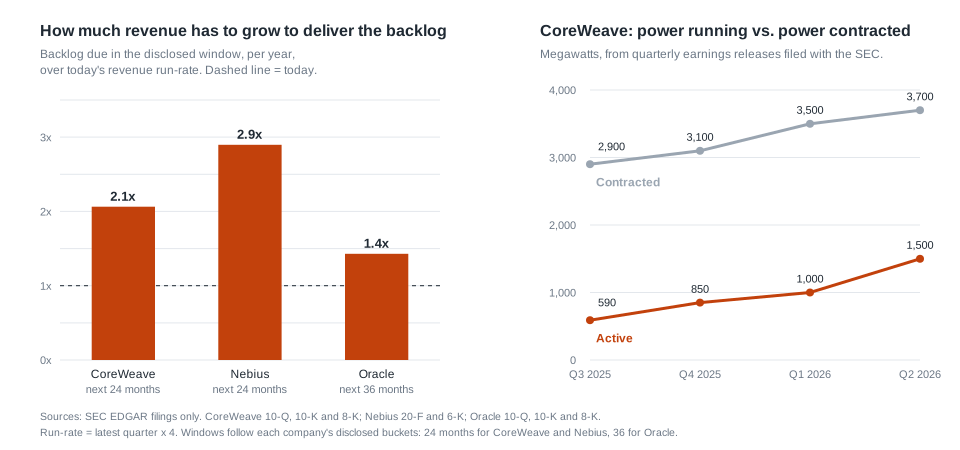
The promises are large. CoreWeave reported $103.7 billion of remaining performance obligations, its contracted backlog, at the end of June, 41% of it due within 24 months.1 That's about $21 billion a year, against a current revenue run-rate of $10.3 billion. Nebius needs close to three times its current revenue run-rate to deliver what it says is due in the same window.2 Oracle's backlog, which includes its software business, is $664 billion, half of it due within 36 months, and it has signed another $288 billion of data-center leases that haven't started.3 None of that revenue arrives until a building is finished, connected to power and filled with chips.
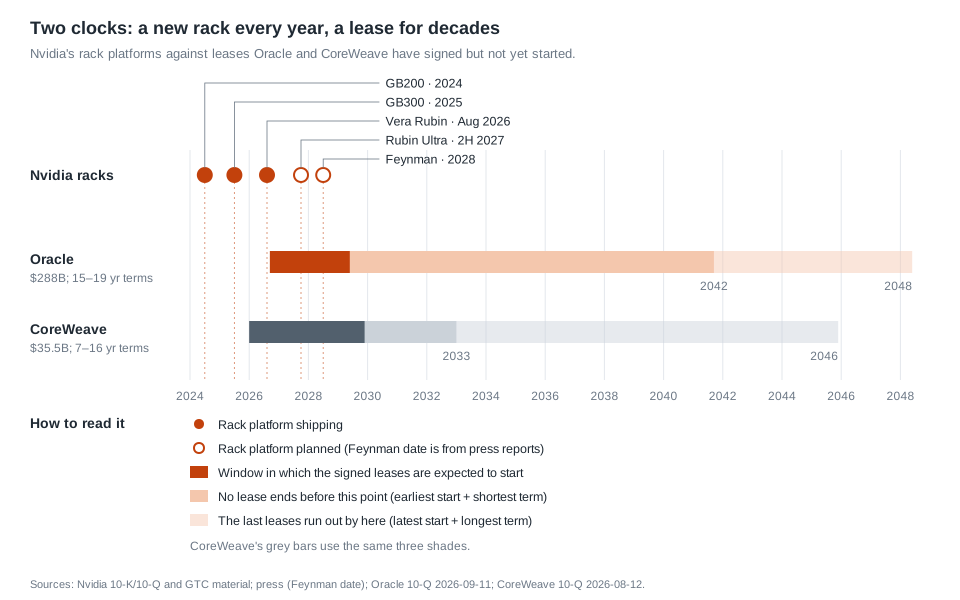
The trouble is that the chips and the buildings run on different clocks. Nvidia brings out a new data-center platform every year. Vera Rubin began production shipments in August. It keeps the rack footprint and liquid cooling of today's Blackwell racks but draws more power per rack, and Nvidia hasn't published how much.4 The bigger break is Kyber, a new rack that runs on 800-volt DC power and needs new electrical distribution at the building level. Even that target keeps moving. Nvidia first tied Kyber to Rubin Ultra in the second half of 2027, then in March moved its largest configuration to the generation after.4 A data center takes years to permit and build, and Oracle's unstarted leases run 15 to 19 years.3 Many of these buildings will be designed around one rack and finished in the era of the next.
Meta showed what a big enough change costs. In 2022, redesigning for AI, it wrote off $1.34 billion of data-center assets in "a pivot towards a next generation data center design, including cancellation of multiple data center projects."5 Yearly chip updates are smaller steps than that, but they land on buildings that take years to finish. Nobody fills a new hall with old racks, and nobody leaves half of it empty because the new ones are too dense. Denser racks need more power and cooling for every square foot, and they weigh more: a Grace Blackwell rack is about 1.4 tonnes and its Vera Rubin successor about 1.6.6 A ground-floor slab can usually be thickened for that. On the upper floors of a multi-storey building, or in an older hall designed for lighter loads, it can mean redesigning the structure. None of this can stay a moving target. At some point someone has to fix the loads and build to them.
That decision runs into how these buildings get built. The filed contracts show them going up under a guaranteed maximum price.8 A GMP only works once the design is set. The contractor commits to a ceiling, and its profit is whatever it can keep under it, on margins of a few cents on the dollar: Turner, the largest US data-center builder, earns about that before tax.7 So it builds exactly to the spec and nothing more. Any change to the design reopens the price as a change order. The contract will typically also set liquidated damages for missing the completion date, but they're negotiated, usually capped, and far smaller than the delay credits the owner owes its tenant.8 The filed leases put most of the construction risk on the developer: it funds cost overruns, and if it delivers late the tenant gets rent credits and, past a final deadline, can walk away.8 But the tenant isn't clear of it. At one 393 MW site, CoreWeave's rent is "based on construction costs incurred by the lessor," up to $14.7 billion over 16 years, and its 10-Q warns of "increased partner costs that are passed on to us."1 Design changes the tenant asks for are the tenant's to pay for.8 And even when the developer pays for a delay, the tenant can't sell compute it doesn't have. It misses the revenue it guided to, and it still owes its own customers: Nebius's contract with Microsoft carries "liquidated damages for late delivery."2
Then there's everything nobody in this chain controls. Last month Oracle sent a force majeure notice to the developer of Project Jupiter, a 2.45-gigawatt Stargate campus in New Mexico due online in 2028, after the gas pipeline meant to power it slipped nearly six months on permit denials. According to press reports, the notice could let Oracle push its rent back by up to three years, though it would still owe the full lease term once payments start.9 The step-up transformers that connect new power plants to the grid now take more than 160 weeks to arrive.10 CoreWeave lists New York's July 2026 moratorium on data centers drawing 50 MW or more as a risk.1 High-speed rail learned this early. The California State Auditor found in 2018 that the authority had started construction before it secured the land, worked out how to relocate utilities or signed agreements with outside parties.11
Small slips already show up in the filings. Applied Digital promised CoreWeave's second Ellendale building for the middle of 2026 and declared it ready on October 1, about a quarter later.12 And the dates these companies publish are in effect best-case dates. On a megaproject you'd report a best case and a worst case and fund the worse one. Investors get one date, and the documents that would let them test it are redacted. In the three CoreWeave leases Applied Digital has filed, the target delivery dates, the grace period, the late-delivery credit rate and even the definition of force majeure are all blacked out.8 Even the measure I'd watch first, construction spending against power coming online, is only reported in full by CoreWeave. On that measure it's keeping up. But its $11.9 billion of construction in progress is its own equipment and fit-out; the landlords' building work never reaches its balance sheet.1 The bond market is already charging for risk, of which construction is only one part. CoreWeave's 9.75% notes due 2031 traded near 80 cents on the dollar this month, a yield of about 15.5%, and a data center leased only to CoreWeave had to pay 9.25% to borrow in September.13
So here's the question I'd put to management on the next call. What rack density are the buildings behind the next 24 months of revenue designed for, and when a design changes or a date slips, who pays: you or the developer?
Notes (SEC EDGAR filings unless marked PRESS or OTHER)
- CoreWeave, Form 10-Q for the quarter ended June 30, 2026 (accession 0001769628-26-000366): remaining performance obligations, property and equipment, leases, risk factors. Earlier quarters: Forms 10-Q, the FY2025 Form 10-K and Form 8-K earnings releases. Run-rate is the latest quarter's revenue × 4. ↩
- Nebius Group, Form 6-K exhibits for Q2 2026 (0001104659-26-094844, 0001104659-26-094568) and earlier quarters; FY2025 Form 20-F (0001104659-26-052948); Form 6-K of September 8, 2025 on the Microsoft agreement. ↩
- Oracle, Form 10-Q for the quarter ended August 31, 2026 (0001193125-26-389274): remaining performance obligations and lease commitments (15–19 year terms); FY2026 Form 10-K (0001193125-26-277521). ↩
- NVIDIA, Form 10-Q filed August 26, 2026 (0001045810-26-000075): Vera Rubin "began production shipments in the third quarter of fiscal year 2027." OTHER: NVIDIA technical blog and GTC 2025–2026 material on the Kyber rack and 800-volt DC power. ↩
- Meta Platforms, FY2022 Form 10-K (0001326801-23-000013): restructuring note, data center assets $1,341 million. ↩
- OTHER: server-maker datasheets and industry reports on GB200/GB300 and Vera Rubin NVL72 rack weights. ↩
- OTHER: HOCHTIEF AG (Turner's parent), 2025 results. ↩
- Applied Digital, Form 8-K of June 2, 2025 with the CoreWeave lease exhibits; Galaxy Digital, Helios credit agreement filed October 20, 2025 (an AIA A102 GMP contract); Core Scientific, Form 8-K exhibit 99.2 filed April 21, 2026 (GMP contracts; liquidated damages capped at the builder's fee on one). OTHER: AIA A102-2017, §5.1.6, where liquidated damages are an optional term. ↩
- PRESS: Bloomberg, TechCrunch and CNBC, September 24–25, 2026. Oracle has not filed anything with the SEC on the notice. ↩
- PRESS: Reuters, citing Wood Mackenzie, July 9, 2026. ↩
- California State Auditor, Report 2018-108, November 2018. ↩
- Applied Digital, Forms 8-K of June 2, 2025 and October 7, 2026. ↩
- PRESS: CNBC, October 14 and 19, 2026; Bloomberg, September 23, 2026. Bond prices are market data, not SEC disclosures. ↩
Not investment advice. The author holds no position in CoreWeave, Nebius, Oracle or Nvidia.